It’s not too late to join us at the London VMUG – 23rd June 2016

Just a quick note to remind everyone that it’s not too late to register for the London VMUG tomorrow (23rd June 2016), at TechUK, 10 Saint Bride Street, London, EC4A.

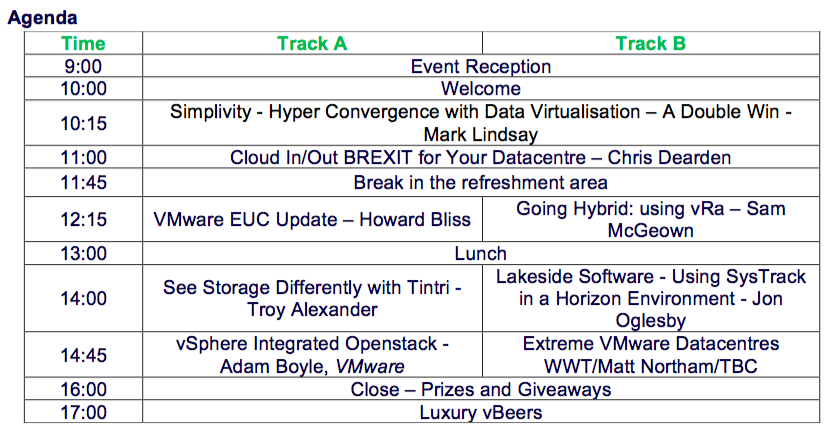
The new team has an awesome agenda lined up, including:

  • A Brexit Special (Cloud – In or Out)
  • Sam “VCDX baby, yeah!” McGeown on vRA hybridity
  • A very interesting looking session on VIO from VMware

I will sadly miss the last of these as I will be in the other track. Having changed my name by deed poll to “TBC”, I will be assisting the inimitable Matt Northam, talking about “Extreme VMware Datacentres”. I will be following the basic principles of PechaKucha, minus the actual time limit. I may even get through my 20 slides in as little as 5 minutes, so don’t blink or you’ll miss it! 🙂

Extreme!To wrap up the evening there will also be a Luxury vBeers event, so make sure you vote when polling stations open at 7am, so you don’t have to go rushing home after! 🙂

AgendaJune2016.pngLastly, thanks to our sponsors, Simplivity, Lakeside Software and Tintri; without them we would not be able to have such great events and an awesome venue!

If you do see me on the day (I’m 6’7” so you cant miss me), please do come and say hi! 🙂

VMUG, VMware , , , , , ,

StorageOS – An array based on containers? It’s like storage for millenials!

Last week I managed to catch up with the guys from StorageOS, a new container-based storage company, headquartered in London. I found out about them at a London Storage Beers event a few weeks ago, and my first question was, what the hell is container-based storage, and how does it work?!

They started from the premise (yes that’s actually the correct use of the word premise!), that if you want to build a storage system FOR containers, what better way to do it than to build it FROM containers. StorageOS therefore offer what they describe as “full enterprise storage array functionality, delivered by software, on a pay-as-you-go basis”. They also plan to offer a free-forever Developer tier, which includes everything except HA functionality which you would obviously need for production usage!

StorageOS Announcement

So the good news is, today (Monday 20th June 2016) StorageOS are announcing the release of their Beta at DockerCon, so you can now download and test out their new storage platform.
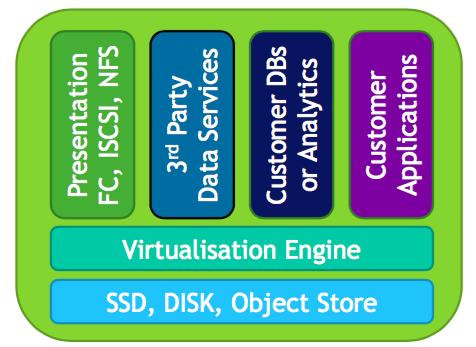
The StorageOS Stack

The StorageOS Stack


You can deploy this StorageOS software anywhere from bare metal to containers:
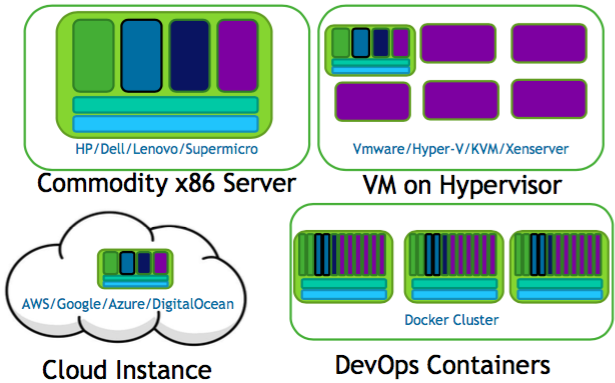
StorageOS - It's software, so it runs anywhere!

It’s software, so it runs anywhere!

Appliances for some of the larger clouds are in the works, but will not be available on day zero.

They can then consume any back-end storage, from SSD, HDDs and virtual drives, to EBS volumes, object stores, etc. You then pool all of capacity from all devices into a capacity pool, which is deduped, encrypted, and available across all nodes, and carve out volumes to present to systems like Docker through their own native Docker driver, or (slightly oddly) iSCSI / FC!!! They even have VAAI support in development!

Overall, I think it’s a pretty interesting product. At first look it feels a bit like a traditional array in a container package, much like if you containerised an enterprise app, then just utilised as a traditional array with some container plugins, instead of being very targeted and container-specific. StorageOS do have an OS driver to let you mount their volumes direct from containers, but there are other things out there today which do that anyway (e.g. Flocker).

I would say their messaging is a little inconsistent at the moment, and adding things like FC integration early on feels a bit odd if they’re positioning themselves as a container play. They do however state clearly that they’re targeting enterprises and want to make the on-boarding process as simple and friction-less as possible. I do worry that this “all things to all people” approach could be a wee bit risky at this early stage, and being more laser focused in the short to medium term would allow them to differentiate more.

StorageOS Cloud

The founders were very specific when they stated that they were building a clustered array with synchronous remote replicas, not a distributed storage array. Async replication is coming, which will be critical to maintaining performance in a hybrid cloud or multi-cloud setup. I really like the fact that you can stretch the same hybrid storage environment between your on-premises and cloud infrastructure using a single storage solution. This same solution can actually be used to span multiple public clouds as well, providing a resilient storage solution between say AWS and Azure, all of which is deduped and encrypted of course! This could be very interesting indeed, as customers look to protect their workloads from large public outages!

Finally, the StorageOS software is built (as you would expect these days) with APIs at the heart of everything. Even the modern GUI is really just based on API calls to the back end.

The Tekhead Take

Anyway, enough gabbing… It’s still early days, but the storage experience of the founders is certainly solid! Who better than ex-storage admins to provide a product that works well for storage admins?! I’d say there’s a good chance of this becoming a pretty cool product in the future, so definitely one to watch!

You can find a link to their website and beta sign up here:
http://storageos.com/index.php/product/
StorageOS hipster-approved storage

Docker, Startup Spotlight, Storage , , , , , , , , , , , ,

NanoLab – Index of Tekhead.it Posts on Intel NUC VMware vSphere Homelabs

Starting in January 2013, my Intel NUC series is now over has reached the heady heights of double digits over the past few years, so I figured it might be handy to make them a bit easier to find!

Nanolab Posts

More posts coming soon… 🙂

Just in case I forget to keep this page updated:
http://tekhead.it/blog/category/nanolab/

Intel NUC Nanolab blog posts

Intel NUC, NanoLab, VMware , , , , , , , , , , , , ,

Data Corruption – The Silent Killer (aka Cosmic Rays are baaaad mmmkay?)

If you have worked in the IT industry for a reasonable amount of time, you have probably heard the term bit rot, referring to the gradual decay of storage media over time, or simply Data Corruption. What I never realised was what one of the primary causes is behind bit rot, and the amount of effort the storage industry goes to prevent it!

At Storage Field Day 9 we attended one of the most genuinely fascinating and enjoyable sessions I have ever seen. It was “proper science”!

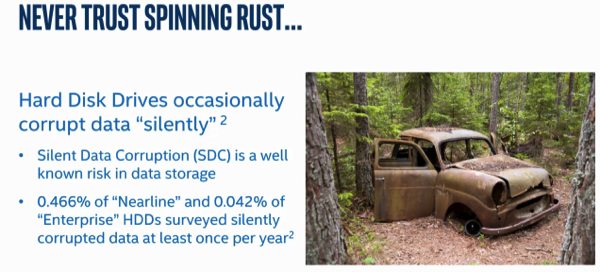
Apparently one of the dominant causes of data corruption in SSDs, is in fact something which completely blew my mind when I heard it! Believe it or not, bit rot and data corruption is often caused by cosmic rays!

data corruption rust.png

Cosmic Rays cause Data Corruption!

These cosmic rays are actually protons and other heavy ions which originate from the Sun, or even distant stars! Next thing you know these evil buggers are coming down here, taking our bits and stealing our women! Ok, maybe not the last part, but they’re certainly interacting with other elements in our atmosphere and generating storms of neutrons (we walking flesh bags actually get hit by about 10 of them every second but as we’re not made primarily of silicon, no biggie on the data corruption front!).

These neutrons occasionally also then slam into integrated circuits, and more occasionally still, this causes a bit to flip from a 0 to a 1, or vice versa.

data corruption mind blown.jpgNow a flip of a single bit might not seem like a lot, especially with CRC and other features in modern HDDs, but the cumulative effect or a large number of these flips can lead to corrupt data. Furthermore, corruption of even a single bit of certain data types, such as the vast quantities of DNA data we plan to store in the future, could mean the difference between you being diagnosed with cancer or not!

As such, Intel have introduced a feature within their SSDs which will deliberately brick the drives if they detect too many bit flips / errors! More amusingly, they adopt “aggressive bricking“, i.e. brick the drives even when minimal data corruption is detected! A brilliantly ironic description for something which is actually trying to protect data, as this has the effect of causing your RAID or Erasure coding data protection to rebuild the drive contents on another drive, therefore ensuring that you don’t end up with corrupt data replicating etc.

Intel actually test this using a particle accelerator at Los Alamos Neutron Science Centre, by firing neutron beams at their drives and checking the data corruption rates! But don’t worry about the poor drives… it’s all over in a flash! 😉

This is genuinely an absolutely fascinating video and well worth spending 45 minutes watching it:

Also for those of you who may notice some snickering and shaking of shoulders going on in the video, it was partly down to the crazy awesomeness of the subject, but also due to some very humorous twitter conversations going on at the same time! I finally understand the meaning of the term corpsing now, having most definitely experienced it during this session! Vinod did an awesome job of putting up with us! 🙂

data corruption cosmic rays.png

Further Info

You can catch the full Intel Session at the link below, which covers other fascinating subjects such as 3D XPoint, NVMe, and SDS – They’re all well worth a watch!

Intel Storage Presents at Storage Field Day 9

Further Reading

Some of the other SFD9 delegates had their own takes on the presentation we saw. Check them out here:

Disclaimer/Disclosure: My flights, accommodation, meals, etc, at Storage Field Day 9 were provided by Tech Field Day, but there was no expectation or request for me to write about any of the vendors products or services and I was not compensated in any way for my time at the event.

Storage, Tech Field Day , , , , , , , , , , , ,